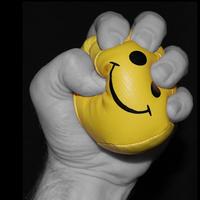
Stress may save your life if you're being chased by a tiger. But if you're stuck in traffic, it may be more likely to make you sick. This hour, a long hard look at the body's system for getting out of trouble.
Stanford University neurologist (and part-time "baboonologist") Dr. Robert Sapolsky takes us through what happens on our insides when we stand in the wrong line at the supermarket, and offers a few coping strategies: gnawing on wood, beating the crap out of somebody, and having friends. Plus: the story of a singer who lost her voice, and an author stuck in a body that never grew up.

We can’t control stress, but what we can do is understand it. Neuropsychologist Dr. Kamran Fallahpour let’s us listen to the sound of our own stress (a sort of a high pitched whine). His theory is that if you can hear your stress you can control it. Not ...
We now know that too much stress makes you sick. Fifty years ago, we had no idea. Credit an upholsterer, a chair, and some lab rats. Dr. Paul J. Rosch, President of the American Institute of Stress, describes a series of not so nice things he and his colleagues did ...
Stress can make fairy tales turn to nightmares, and it can make an enemy of your own body. Producer Ellen Horne speaks with Linda Thompson, famous folk singer whose voice one day flew away. Thompson describes her rare condition, called Hysterical Dysphonia, and how she overcame her body's silence. Dr. ...
Comments [38]
I was also horrified by Dr. Robert Sapolsky's description of his experiments. I wish this hadn't been handled with such humor. I can't see any benefit to human knowledge about stress that would counteract torturing other living beings. Glad other listeners found this bit as disturbing as I did.
Dear Radiolab people, During the earlier part of this particular radio show, you featured a voice over artist who spoke of "great moments" of phycoligy (?) waiting room furniture maintenance (?) can't remember at this time, do to the fact that my brain is having a silly moment. However, I do remember this fellow did a rather spot on job in recreating the style of voice overs of yesteryear (thinking of the news reels one would see while attending movie matinees in the 1940's, for example). So, my question is: Who is this guy ? And, how might I be able to get in touch with him. He'll be the perfect "go to" guy for some production work I'll be doing in the, not so distant future. Thankyou ! Sincerely, DK.
One of the songs was "Guilty Cubicles" by Broken Social Scene. I, too, am trying to locate the rest of the music clips played within the segment. Great segment, overall.
@alayne from south dakota. Think you are looking for "Piece Peace," by Bill Evans.
Have y'all listened to this TED talk about stress? It strikes me that this perspective on stress would've made a nice addition to the program! http://www.ted.com/talks/kelly_mcgonigal_how_to_make_stress_your_friend.html
After my twin pregnancy, I was cooked and scared about my - quick to snap - new self. My chiropractor saved me with a simple remedy that added restored my 'band width'. He suggested that my adrenal system was sapped post pregnancy and offered a bovine extraction of adrenal support supplements. It helped me... saved me!
Good story - enjoyable to listen to as always.
I'm wondering how you find out what music is played during the show? Is there a list of the musicians/music from each of the talks that you guys do?
Thanks!
Was just listening to this episode for the first time at work. Upon getting towards the end of the first "intense" story, I began to feel faint so I turned off the podcast. I'm normally a bit squeamish, even from seeing certain merdical-related images. But this was the first time that I felt this bad due to audio cues and an overvivid imagination. I figured "let's turn this off for a bit, I'll resume Radiolab in a second when I've recovered my wits".
So I turned it off. But I felt myself getting further and further into the fainting spell. It wouldn't have been the first time I passed out from sheer anxiety (as has happened to me when donating blood), but it definitely wouldnt be a commonplace thing for me either. I tried to slow my breathing, being fully aware of where this was heading if I didn't take control of my situation soon. For some reason, I thought that distracting myself with singing the "Akuna Matata" tune from Lion King would prove to be a sufficient distraction to get the anxious thoughts out of my head, but in doing so I forgot to control my breathing. I was very aware how close I was to fainting.
Next thing I know I'm hearing distant voices asking, "Are you sleeping?" as I wake up on the hard surface that is my desk. I quickly laugh it off, since I was really fine, but I gave my 2 nearby coworkers a good scare as I apparently hit my head hard against the desk. And my head doesnt even hurt. I guess I could've gotten hurt, but I found this all to be extremely amusing and funny. I'll have to go back and finish listening to the story later on.
Excellent show. Couples/parents who spend their lives screaming at each other, or complain about everything, should learn that the stress caused is taking life away, especially when it becomes a way of life; plain and simple, stress kills
I listened to this story on stress and was horrified by the experiments that were carried out on the rats. I am a veterinarian and other members of our staff were listening and couldn't believe the way they casually talked about the torture of these animals. My husband, who was listening with our kids called to warn me and tell me how upset they were and couldn't beleive it was true OR that it was aired on NPR.
I am usually a big fan of Radiolab but after that, I, my family and coworkers are taking a break from listening.
The song is:
Erik Satie – "Trois Gymnopédies"
http://www.youtube.com/watch?v=q7DBoiyBoJ8
It was very upsetting to hear of the torture of rats, and the laughter about this during the discussion about the electrical shocks to them. There is something not right about people who are amused by these things.
I am a 4th year med student and mother of two. This show is absolutely amazing from an entertainment/production point of view, also extremely important from a medical point of view. Bravo, Radiolab. And thank you.
I agree with Noelle Wiggins from Portland Oregon. Here are the heart attack rates by race: Whites 25.1, African Americans 24.5, Asians or Pacific Islanders 23.2, Hispanics 20.8, American Indians or Alaska Natives 18.0. So are you saying Whites and African Americans more type A than Hispanics and Native Americans? Are Asians less type A than Whites and African Americans? Or could it be there are several sources of stress and damage at work in heart disease?
I am really saddened and upset to hear about the "stress experiments" on rats: shocking them until they bite eachother, starving them, freezing them, etc.. Wanting to understand why we feel the way we feel never justifies torturing other living beings. It is important to expose these types of things, but to joke about them is cruel and misguided.
I usually really enjoy and learn a lot from Radio Lab. But as a public health practitioner, I was frankly shocked that Radio Lab did an entire show on stress and did not talk about the associations between chronic stress and the persistent health inequities that divide our society. I would strongly suggest that the producers and all listeners watch all the episodes of the documentary, "Unnatural Causes," particulary the first episode, which focuses on the causes and effects of chronic stress. The Unnatural Causes series, which appeared on PBS, has an excellent website. Here is the link: http://www.unnaturalcauses.org/. Unfortuately, by ignoring how chronic stress disproportionately affects people of color, people living in poverty, and others who experience systematic discrimination, this episode of Radio Lab perpetuates the idea that NPR and public broadcasting only speak to the experience of a very small sliver of our society.
Please tell Linda Thompson about the energy work modality EFT. She may be able to 'tap' herself back to a healthier relationship between her brain and her vocal capabilities. DM
Ugh... the researcher (Sapolsky?) who described his hideous torture of rodents gave me stress. Sewing their eyelids open? Freezing them on rooftops during a Canadian blizzard, forced-swim stress tests, electric shocks, food deprivation...? The knowledge that experimenters do this, and are funded for doing this to animals, is truly disturbing. The commentator is laughs. The zapping sounds are NOT funny.
Not amused. Stressed and angry.
The work of Dr Richard Brown, Patricia Gerbarg and Stephen Elliot give great relief from stress of all kinds by using simple breathing techniques. See their websites for remarkable tools to move us from the overwhelming habit of being stress most of the time.
www.haveahealthymin.com
www.coherence.com
Does anyone know the name of the lovely, wistful and melancholy song..it was played on the piano...more towards the beginning of today's Stress program..
I think it's an old melody..
thanks-!
alayne
ethnically cleansed by Serbs, oh c'mon.. really?
Hi, Tony
The revolutionary and scientifically validated holistic, preventive wellness system called Alphabiotics,instantly releases stress in the brain and the body, causing a profound effect on your health.
<a href=http://www.alphabioticbalance.com/>pain</a>
<a href=http://www.alphabioticbalance.com/>stress</a>
<a href=http://www.alphabioticbalance.com/>chiropractor</a>
<a href=http://www.alphabioticbalance.com/>balance</a>
Thanks
ferozrana17
Tigers on the Savannah??? The impala would be 'what are you doing in Africa?'
avram- erik satie gymnopedie 1
At 5:50 there is a song that begins playing in the background. Can anyone PLEASE tell me what the piece of music is called and who the composer is?
Your help would be much appreciated. I have been searching for this information for years. Thank you,
Avram
@Julie -- Actually, school is exactly where I first heard Radiolab! It was a psychology class, and he played us "Musical Language." It was about two years later that I remembered it and looked it up; now I listen to Radiolab all the time!
Sorry, I had to point out that impala live in Africa and tigers don't, lion is better.
I fainted from listening to this episode while driving. Definitely should have heeded Jad's disclaimer on the first story! Don't worry though, my passengers and I were fine.
This show is beyond awesome! i listened to one show, after which i immediately started from the 1st episode and making my way back! new lifelong fan!
The song at ~36:10 is Guilty Cubicles by Broken Social Scene.
@Pertti That song is amazing, I know I have it in my itunes, but I forgot what it is called and who its by. Did you have any luck figuring it out? Does anybody know? It kicks in around 36:08.
Thanks guys!
A friend played me a show of Radiolab and after that I downloaded all of the shows and listened all of them almost nonstop. This is the best radio show ever. The production values are through the roof. I just wish there was a new episode every day. I tell all my friends about this show. What is the guitar tune on this show starting at 36 min 8 sec? It's mesmerizing and I would like to hear more of it.
You guys rule.
Cheers,
Pertti
there's nothing more awesome than RadioLab. If only schools taught this way, our kids might learn a lot more!
I've been listening to Radiolab for about a year now and I always revel in the sense of wonder and questioning in this quality programming.
I've noticed that many of the stories revolve around medical anomalies and this has meant a great deal to me. I developed a condition a year and a half ago that looked like a very intense form of turrets and epilepsy, but never found a diagnosis despite seeing a myriad of specialists. I've felt so connected to many of the guests and their experiences often shed light onto my own.
Thank you so much, keep up the great show!
thanks Tony!
Thank you Tony!
Luis, the music is one of Erik Satie's "Trois Gymnopédies".
Can someone tell me the name of the song used in Dr. Kamran Fallahpour lab to relax (and interrupted by phone ring) ?
Leave a Comment
Email addresses are required but never displayed.